
Few things test a partnership faster than a newborn’s nights, and few conversations get skipped as often as the one about who’s actually doing what overnight. It’s easy to default into a pattern without ever deciding on it, and that default has a way of quietly favoring whoever falls back asleep faster or whoever isn’t breastfeeding, until one person is running on fumes and the other genuinely doesn’t realize how bad it’s gotten. Talking about nighttime duties explicitly, and revisiting the plan as things change, tends to head off a lot of resentment before it builds.
Why this needs an actual conversation, not just an arrangement
It’s tempting to let nighttime duties sort themselves out organically, especially in the first exhausted weeks when neither of you has the bandwidth for a planning meeting. The trouble is that “organic” arrangements tend to calcify around whoever responds first to a cry, which is often the birthing parent, especially if breastfeeding is involved, and especially if the other parent has an easier time sleeping through early whimpers. A few weeks of that becomes a pattern, and a few months of that pattern becomes an assumption about whose job this is, one that’s genuinely hard to unwind later because it was never actually agreed to in the first place.
Having an explicit, even if imperfect, conversation about how nights will be split does two things: it makes the division of labor visible, which matters because invisible labor is very easy to underestimate from the outside, and it creates a plan you can both point back to and adjust, rather than a set of assumptions neither of you remembers agreeing to.
What’s actually being divided

Nighttime duties aren’t one task, and it helps to break them apart before deciding who does what. There’s waking up to a cry in the first place, which is its own form of labor even before any action is taken. There’s the feed itself, whether that’s breastfeeding, which only one parent can physically do, or bottle-feeding, whether from pumped milk or formula, which either parent can do. There’s diaper changes, resettling the baby afterward, and often a stretch of pacing or rocking if the baby doesn’t go back down easily. And there’s the mental load of anticipating the next wake-up, which tends to fall on whoever is already half-listening even when it’s not technically their turn.
Breaking it down this way matters because “I do the night feeds” can mean wildly different things depending on how many of these pieces it includes, and couples sometimes discover in the conversation itself that one person thought they were splitting things fifty-fifty while the other was doing most of the actual awake-time.
Common splitting approaches
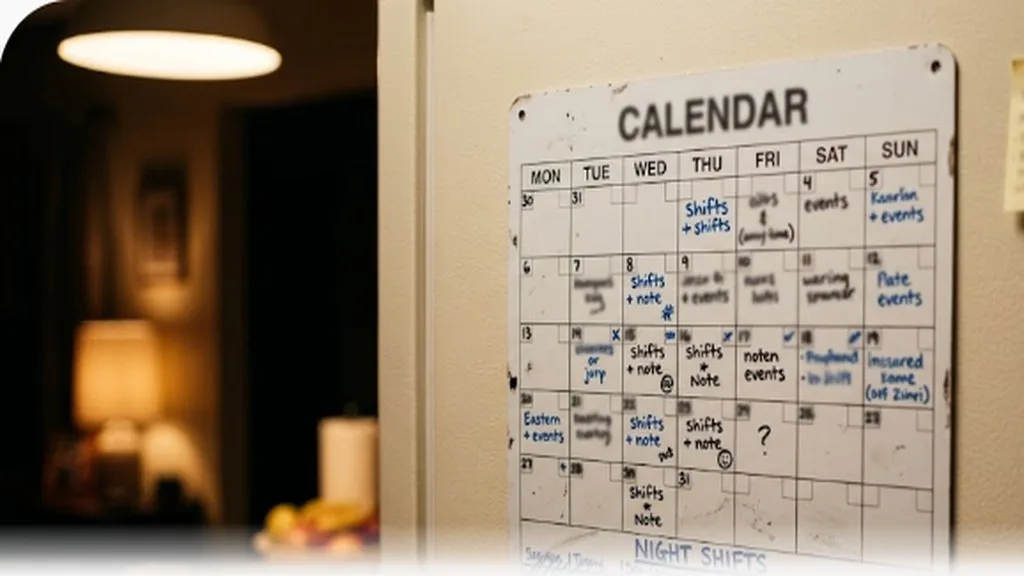
Shift systems are one common approach: one parent takes the first half of the night, roughly bedtime to 2 or 3 a.m., and the other takes the second half, so each person gets one uninterrupted stretch of sleep rather than both being woken repeatedly all night. This tends to work well when both parents can participate in feeding, whether through bottles of pumped milk, formula, or combination feeding, since it requires whoever’s on duty to actually be able to feed the baby without waking the other person.



Alternating nights entirely is another option, where one parent is fully off duty every other night, sleeping in another room if needed to avoid being woken by normal newborn sounds. This gives more complete recovery on the nights off but means one full night of solo duty on the nights on, which some parents find harder than a partial shift.
For breastfeeding parents who are doing all the actual feeds, splitting still matters, just differently: the non-feeding parent can handle every diaper change, all the resettling and rocking after a feed, and getting up to bring the baby to and from the bed or bassinet, so the feeding parent’s job is reduced to the feed itself rather than the whole wake-up-to-resettling cycle. Pumping a bottle or two for the non-feeding parent to handle at least one feed a night, once feeding is well established, is another way to let both parents share the physically hardest part.
When one parent is breastfeeding and going back to work sooner

If one parent has a shorter or nonexistent leave and needs to function at a job the next day while the other is home, it’s worth naming that directly rather than assuming it settles itself. Some couples decide the working parent gets more protected sleep on work nights in exchange for taking on more of the weekend or evening load; others find that doesn’t feel fair and prefer a more even split regardless of the next day’s schedule. There’s no single right answer here, but it works better as a decision you both make than as an assumption one of you is quietly resentful about.
Revisiting the plan as things change
Whatever you land on in week two almost certainly won’t fit by week eight, as feeding patterns change, sleep consolidates somewhat, and one or both parents go back to work or resume other responsibilities. Building in a habit of checking in periodically, even briefly, about whether the current split still feels fair tends to catch resentment before it builds into a bigger conflict. This doesn’t need to be a formal meeting; a five-minute conversation over morning coffee about how the week has felt is usually enough.
When you’re doing this without a co-parent
None of the splitting arrangements above apply if you’re the only adult in the house overnight, and it’s worth being direct about the fact that this is genuinely harder without someone to trade off with. Where possible, this is where outside support matters most: a family member or friend taking an overnight periodically so you get one full night’s sleep, a postpartum doula if that’s financially accessible, or, if you have family living with you, an honest conversation about which nights they can realistically help with rather than assuming they will. It’s also worth giving yourself permission to let some daytime tasks slide in exchange for any nap opportunity, since there’s no equivalent nighttime relief valve available to you the way there is for a two-parent household.
Same-sex and non-birthing-parent households
For two-mother households where one parent is breastfeeding, the same imbalance risk applies as with any breastfeeding household, and the same fixes apply: the non-feeding parent taking over every other part of the wake-up cycle, and bottles of pumped milk when feasible. For two-father households or others where no one is breastfeeding, the split can be more mechanically even from the start, though it’s still worth having the explicit conversation rather than assuming an even split will happen on its own, since old habits and unconscious assumptions about who “naturally” handles a crying baby can creep in regardless of gender.
Tracking who’s doing what, if that helps

Some couples find it useful, at least for the first few chaotic weeks, to keep a simple shared note or app tracking feeds and wake-ups: who did the 1 a.m., who did the 4 a.m., roughly how long it took. This isn’t about keeping score in an adversarial way, but about having actual data rather than each person’s exhausted, biased memory of who’s been doing more. It’s common for both partners to genuinely believe they’re doing the majority of the nighttime work, since the hardest, most tiring parts are the ones that stick in memory, and a few days of real tracking can settle the question more usefully than an argument about it at 3 a.m.
Country-specific notes worth knowing
How much leave each parent has directly shapes what a fair nighttime split even looks like, so it’s worth factoring in alongside the more personal considerations above. In the US, where paid leave for the non-birthing parent is often short or nonexistent depending on the employer and state, that parent may be back at work within one or two weeks, which changes the calculus around work-night sleep protection discussed earlier. In the UK, statutory paternity leave is typically brief, up to two weeks, though shared parental leave can extend a second parent’s time at home further if the couple structures it that way. Canada’s parental leave benefits can be split between two parents in various configurations, sometimes allowing both parents extended time at home, which changes the nighttime math considerably compared to a household where one parent returns to work almost immediately. Australia’s Paid Parental Leave scheme similarly allows some flexibility in how leave is divided. None of this determines what split is right for a given couple, but knowing what leave is actually available before the baby arrives makes the nighttime conversation more grounded than assuming both parents will have equal time and energy to contribute.
FAQ
What if my partner just doesn’t wake up to the baby’s cries?
Some people are genuinely much deeper sleepers, and there’s some legitimate variation here, but it’s also true that people can train themselves to wake more easily when they know it’s expected of them. Before assuming it’s unchangeable, it’s worth trying a system where the awake parent physically wakes the other one for their assigned turn rather than waiting to see if they stir on their own.
Is it normal to feel resentful about the split even when we agreed on it together?
Yes, this is common, especially when exhaustion is high and the agreed-on plan isn’t quite matching reality on a given night. Resentment is worth mentioning out loud rather than letting it build silently, since the plan you agreed on a few weeks ago may just need adjusting rather than being a sign anyone did anything wrong.
Should we split nights evenly even if one of us has more flexibility during the day?
That’s a genuinely personal call, and couples land in different places on it. What tends to matter more than the specific split is that both people feel it was actually decided together rather than defaulted into, and that it gets revisited if it stops feeling fair.
The bottom line
Nighttime duties tend to default toward an uneven split unless a couple actively decides otherwise, and naming that risk early is one of the more useful things partners can do for each other in the newborn stretch. Breaking the work into its actual components, choosing a splitting approach that fits your specific feeding situation, and revisiting the plan as things change are all more effective than hoping it sorts itself out. For solo parents, leaning harder on whatever outside support is available becomes the substitute for a splitting arrangement that simply isn’t available to you, and that’s worth acknowledging rather than measuring yourself against a two-parent model that doesn’t apply.

Hi everyone, i’m Eddy from Africa-Mozambique. I’m Passionate about thing and that’s why i started this blog- to share what i discover. Hope you like and support this project.