
Walk into any baby gear store and the wall of carriers and wraps can feel like its own specialized language — ring sling, meh dai, soft structured carrier, stretchy wrap — with little explanation of what any of it actually means for day-to-day use. Here’s a practical breakdown of the main types, what “ergonomic” really refers to, how to match a carrier to your baby’s current age and weight, and what to actually check before buying one.
The Main Types of Carriers and Wraps
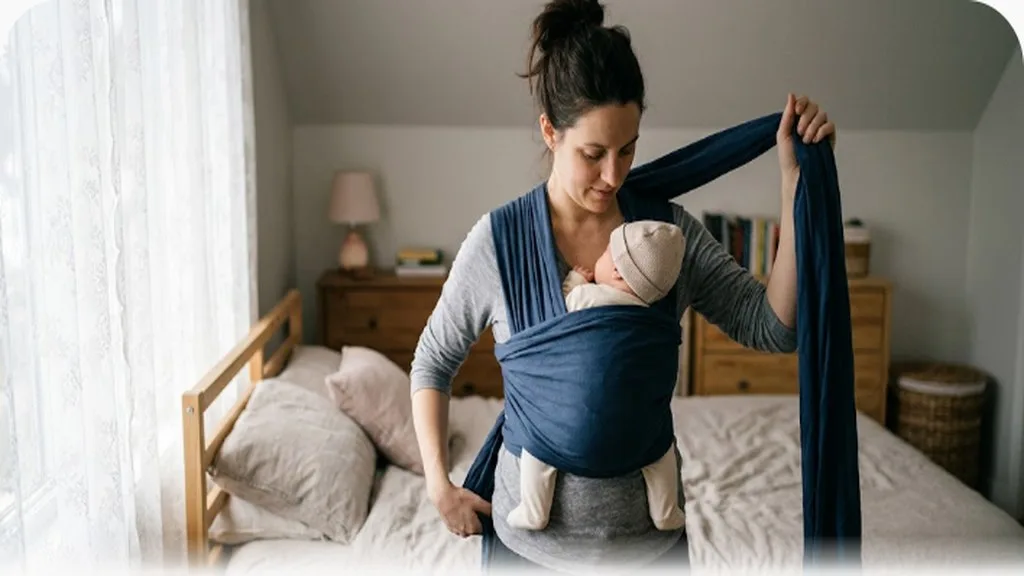
Stretchy wraps are a long piece of soft, flexible fabric tied around the body in a pre-set pattern, usually before putting the baby in. They’re popular for newborns because the fabric molds closely to a small body, but the stretch that makes them cozy for a newborn also makes them less supportive for a heavier baby later on, so most families age out of them within a few months.
Woven wraps use a similar tying method but with non-stretchy, woven fabric, which gives more support across a wider weight range and more positioning options, including back carries once a baby is older — though the learning curve for tying one well is steeper than a stretchy wrap.
Ring slings are a single piece of fabric that runs through two rings to create an adjustable loop, worn over one shoulder. They’re quick to put on and take off, which makes them popular for short errands or for breastfeeding on the go, though the one-shoulder design concentrates weight more than a two-shoulder carrier, which matters more as a baby gets heavier.
Soft structured carriers (sometimes called SSCs) are the familiar buckle-style carriers with padded shoulder straps and a waist belt, closest in feel to a structured backpack. They’re generally the easiest type for a new caregiver to use correctly without much practice, which is a big part of why they’re the most common choice for everyday use from a few months of age onward.
Meh dais sit somewhere in between a wrap and a structured carrier: a rectangular panel with four long straps that tie rather than buckle, offering more adjustability than an SSC with less of a learning curve than a full woven wrap.



What Ergonomic Support Actually Means

“Ergonomic” gets used loosely in carrier marketing, but it refers to something specific and worth understanding: proper support for a baby’s hips and spine. Babywearing organizations recommend what’s often called the “M-shaped” or frog-leg position — knees spread wider than hips and positioned slightly higher than the bottom, with the fabric or panel supporting the baby from knee to knee rather than just under the crotch.
This positioning matters because it mimics the natural position a baby’s legs settle into when held against a caregiver’s body, and it’s considered supportive of healthy hip development, which is relevant for all babies but especially those with hip dysplasia risk factors. A carrier that instead dangles a baby by the crotch with legs hanging straight down — sometimes seen in older or poorly designed narrow-based carriers — doesn’t offer this same support and isn’t recommended by babywearing or hip health organizations.
For a caregiver’s own comfort and back health, the key feature is weight distribution: a well-fitted carrier spreads a baby’s weight across both shoulders and the hips via a padded waist belt, rather than letting it all hang from the neck and upper shoulders. This is one of the biggest practical differences between a cheap, unpadded carrier and a well-designed one, and it becomes very noticeable once a baby passes the fifteen- to twenty-pound mark.
Matching a Carrier to Your Baby’s Age and Weight

Newborns generally need a carrier specifically designed or adapted for their size, since most standard soft structured carriers are sized for babies starting around seven to twelve pounds and a few months of age. Many SSCs include a newborn insert for younger, smaller babies; stretchy wraps and ring slings tend to accommodate newborns naturally without any extra insert, which is part of their early appeal.
Once a baby has good head and neck control, generally by a few months old, most carrier types open up, including forward-facing-out options on some soft structured carriers, though babywearing experts generally recommend limiting forward-facing-out time since it offers less hip support and can overstimulate a baby who can’t easily turn away from input.
Back carries, which distribute weight more comfortably for heavier babies and toddlers, typically require a baby to have strong independent sitting and good trunk control, generally reached somewhere around six months onward, and ideally with some practice assistance (a mirror, or a second person helping) the first several times.
Trying One On: What to Check Before You Buy

If at all possible, try a carrier on with your actual baby, or a similarly sized doll, before buying, ideally at a store or babywearing meetup where you can get a second set of eyes on the fit. Check that the knee-to-knee support described above is present once the baby is in position, that the waist belt sits on your hips rather than your waist (hip-sitting transfers weight much more comfortably), and that your baby’s chin has room — a baby’s chin should never be pressed tightly against their own chest, since that can restrict breathing.
Pay attention to how adjustable the straps and panel width are, especially if you’re planning to use the same carrier for a while as your baby grows, or if more than one caregiver with a different body size will be using it regularly. A carrier that feels fine for five minutes in a store can feel very different after forty-five minutes of real use, so it’s worth a short walk around the store, not just a quick clip-in, before deciding.

Hi everyone, i’m Eddy from Africa-Mozambique. I’m Passionate about thing and that’s why i started this blog- to share what i discover. Hope you like and support this project.