

You walk into the kitchen and stop.
For a second, everything seems normal. You know you came in here for something. Maybe you were going to get your phone, grab a glass of water, check something in the refrigerator, or pick up an object from the counter.
But now you cannot remember what it was.
You stand there trying to reconstruct the thought that was in your head just a few seconds ago.
Then, sometimes, you walk back to where you were before—and suddenly remember.


This strange experience is incredibly common. It is also one of those everyday moments that makes the brain seem almost mysterious.
So why does it happen?
One possible explanation involves something surprisingly ordinary: crossing a doorway.
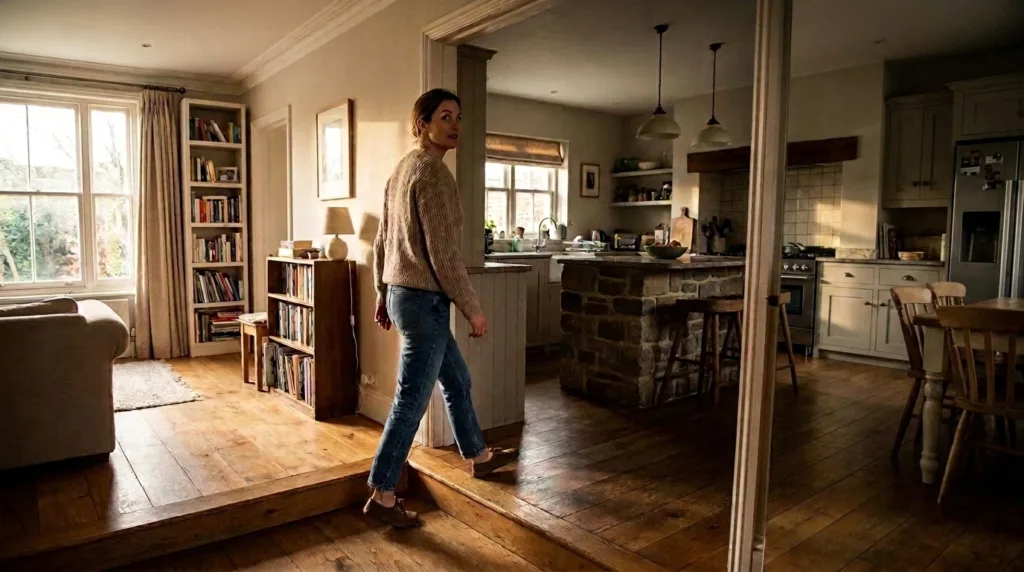
Your brain may be treating the doorway as a boundary
Researchers have found evidence that moving from one location to another can influence what information is readily accessible in memory.
The phenomenon is sometimes called the doorway effect, or the location-updating effect.
In a series of experiments, psychologist Gabriel Radvansky and colleagues at the University of Notre Dame studied what happened when people moved between different rooms while trying to remember objects and other information.
Participants sometimes moved across a large room without changing locations. In other trials, they traveled a similar distance but passed through a doorway into another room.
The results suggested that memory for recently encountered information could become less accessible after a location change. The original research was published in Memory & Cognition, and later experiments examined the effect in both virtual and real environments.
The interesting part is that the doorway itself probably isn’t a magical trigger.
Instead, the doorway may represent something more important to the brain:
a change in the event you’re experiencing.
Imagine your brain keeping a rough mental record of what is happening around you.
While you are standing in the kitchen, your current mental situation might include:
- the conversation you were just having;
- the object you were holding;
- the reason you got up;
- what you were looking at;
- what you planned to do next.
Then you walk into the living room.
The physical environment changes. The objects around you change. Your attention may change. Your brain now has a new situation to process.
That transition can act as an event boundary—a point at which one part of an experience is separated from another.
Researchers studying event cognition have proposed that the brain organizes continuous experience into meaningful events rather than treating every moment as one uninterrupted stream. The University of Notre Dame’s Memory Lab describes this work as an investigation into how the structure of events influences comprehension, learning and memory.
Your brain is not simply “deleting” the thought
This is where the everyday experience can be misleading.
When you forget why you walked into a room, it does not necessarily mean that your brain erased the memory.
There is an important difference between storing information and being able to retrieve it at exactly the right moment.
Memory is not like a computer folder that contains every recent thought in perfect order.
Your ability to remember something depends partly on what else is happening, what you are paying attention to, and which mental context you are currently in.
That means the thought you were trying to retrieve may still exist in your memory system even though it is temporarily difficult to access.
This helps explain why the memory can sometimes return a few seconds later.
You may suddenly see the object you were looking for, return to the previous room, or encounter another clue that recreates part of the original context.
And suddenly:
“Oh! That’s why I came in here.”
The problem was not necessarily that the thought disappeared.
The problem may have been retrieval.
Why changing rooms can matter
Think about the difference between these two situations.
You are standing in your bedroom and suddenly remember that you need to get something from your desk.
You walk across the same room.
Nothing significant changes.
Now imagine that your desk is in another room.
You walk through the doorway.
On the way, you notice your phone. You see a glass that needs washing. You hear someone talking. You notice something on the floor.
Your attention shifts.
The environment changes.
Your brain has new information to process.
By the time you reach the desk, the original intention may no longer be as accessible.
Research on the doorway effect suggests that changes in location can contribute to this kind of memory disruption. In later experiments, researchers found similar location-updating effects under different conditions, including real environments and different ways of testing memory.
One explanation is the Event Horizon Model.
In simple terms, the idea is that the brain creates mental models of ongoing events. When you move into a new situation, the previous event model becomes less active while the new one becomes more relevant.
That can be useful.
Imagine trying to cook dinner while simultaneously keeping every detail from your entire day active in your mind.
That would be terribly inefficient.
Instead, your brain needs a way to prioritize what is relevant right now.
The same mechanism that occasionally makes you forget why you entered a room may help prevent your mind from becoming overloaded with information that is no longer useful.
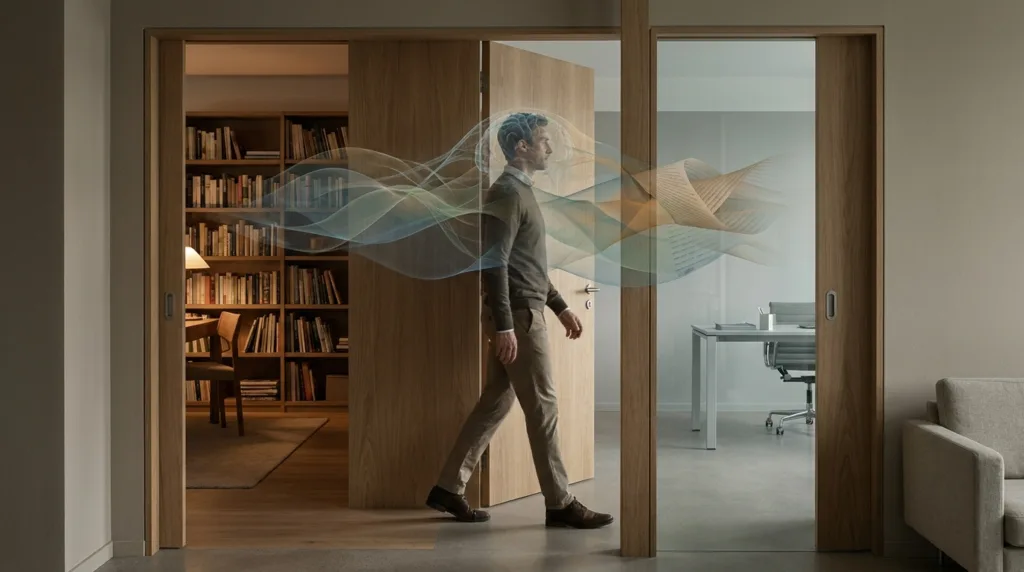
The doorway may not be the real culprit
There is an important scientific caveat here.
The popular version of the doorway effect can make it sound as though crossing a doorway automatically causes people to forget what they were thinking.
The research is more complicated than that.
A 2021 study specifically attempted to replicate the doorway effect across four experiments using virtual reality, video and real-life movement. The researchers did not find a significant doorway effect across their experiments. However, under a working-memory load, they found evidence that recognition performance could become more vulnerable to interference after crossing a doorway. The authors concluded that the results raised questions about how general and robust the original effect is.
That matters.
A good explanation of science should not hide conflicting evidence simply because the simpler version makes a better headline.
The most accurate takeaway is not:
“Doorways make your brain forget.”
It is closer to:
Changes in context and event boundaries can influence memory retrieval, and crossing a doorway is one situation in which this effect has been observed—but the size and reliability of the effect can depend on the circumstances.
More recent research continues to explore how event boundaries affect memory. For example, a 2024 study reported a replication of the original doorway-related effect using a visual working-memory task and found that crossing an event boundary could affect performance.
So scientists are still refining the picture.
The doorway is interesting not because it is a special object, but because it provides a simple way to study how the brain divides continuous experience into separate events.
Why do we forget things even without a doorway?
This is probably the most important part of the mystery.
You do not need to walk through a doorway to forget what you intended to do.
Everyday forgetting can happen for many reasons.
One of the biggest is attention.
Suppose you decide to send someone a message. Before you open your phone, another notification appears. You read it. Then you check another app. A few seconds later, you are scrolling through something completely unrelated.
Your original intention has been pushed out of the spotlight.
The memory may still be available, but your attention is now directed somewhere else.
Working memory also has limited capacity. It allows us to temporarily hold and manipulate information, but it cannot keep every thought equally active at once.
That is why interruptions can be so effective at derailing intentions.
The doorway simply provides a particularly memorable example because the change in physical environment gives us a clear boundary between “before” and “after.”
Why does going back sometimes make you remember?
This is one of the strangest parts of the experience.
You walk into another room.
You forget.
You return to the original room.
And suddenly you remember.
It feels almost as though the room itself stored the thought.
But there is a more ordinary explanation.
The original environment contained information associated with your intention. Returning there can restore some of those contextual cues.
Your brain is once again surrounded by the sights, objects and spatial arrangement that were present when the intention was active.
That does not guarantee that the memory will return, but it can provide useful retrieval cues.
Interestingly, some doorway-effect experiments have tested whether returning to the original environment restores memory. In one line of research, returning participants to the original room did not simply eliminate the memory disruption, which suggests that the phenomenon cannot be explained only by ordinary context-dependent memory.
In other words, there is no single “memory room” mechanism that completely explains the experience.
Several cognitive processes can interact.
Can you prevent the “Why did I come in here?” moment?
You cannot eliminate everyday forgetting, and you probably do not need to.
But you can make important intentions easier to retrieve.
Say the intention out loud
If you are walking to another room to get something important, briefly naming the goal can help keep it active.
“I’m going to get my passport.”
That is more specific than simply thinking, “I need something.”
Reduce unnecessary interruptions
If you are already holding a short-term intention, checking a notification or switching tasks gives your attention something else to process.
When the task matters, finish it before opening another mental tab.
Use environmental cues
If you need to remember something later, place a visual reminder somewhere you will naturally encounter it.
For example, putting an item beside your keys can make the environment itself part of the reminder.
Write important intentions down
For genuinely important tasks, do not rely entirely on working memory.
A note, reminder or calendar alert is more reliable than hoping your brain will preserve an intention while you move through a busy day.
And there is another useful lesson here:
Forgetting something for a few seconds does not automatically mean your memory is failing.
Human memory is designed to be selective.
It prioritizes information, updates with changing circumstances and sometimes makes information temporarily difficult to retrieve.
The occasional blank moment when you walk into a room is therefore less like a computer malfunction and more like a side effect of a system that is constantly deciding what deserves your attention.
So, why did you forget why you walked into the room?
There is no single answer.
Sometimes the culprit is distraction. Sometimes it is a weak or poorly encoded intention. Sometimes your attention has simply moved to something more interesting.
And in some circumstances, crossing an event boundary such as a doorway may make recently relevant information harder to retrieve.
The fascinating part is that the experience reveals something much bigger about memory.
Your brain does not experience life as one continuous recording.
It organizes experiences into changing situations and events. As the world around you changes, your mental representation changes with it.
A doorway may therefore be less of a memory eraser and more of a visible marker of something your brain is doing all the time:
updating the story of what is happening right now.
So the next time you walk into a room and suddenly think, “Wait… why am I here?”, don’t assume your memory has failed.
You may simply have crossed from one mental event into another.
Frequently Asked Questions
Is the doorway effect real?
Research has found evidence for a doorway or location-updating effect in several experiments, including studies using virtual and real environments. However, other researchers have failed to reproduce the effect under some conditions. The best interpretation is that event boundaries can influence memory, but crossing a doorway does not automatically cause everyone to forget.
Does walking through a doorway actually erase a memory?
No. The phenomenon is better understood as a temporary change in memory accessibility or retrieval. Forgetting something momentarily does not mean the information has been permanently erased.
Why do I sometimes remember what I forgot after returning to the previous room?
Returning can restore environmental cues associated with the original intention. Those cues may help retrieval, although research suggests that simply returning to the original location does not always restore memory.
Can distractions cause the same problem?
Yes. Distractions and interruptions can compete for attention and make it harder to maintain an intention in working memory. The doorway effect is only one possible explanation for the familiar experience of forgetting what you intended to do.
Should I worry if this happens often?
Occasionally forgetting why you entered a room is a common everyday experience. However, persistent or severe memory problems that interfere with daily life are a different matter and should not be explained away simply as a “doorway effect.”
Is the doorway effect connected to déjà vu?
Not directly. Both experiences involve interesting aspects of memory and perception, but they are different phenomena. Déjà vu concerns the feeling that a current experience has been experienced before, while the doorway effect concerns changes in the accessibility of recently relevant information across event or location boundaries. See also “Why Does Déjà Vu Feel So Real?” for a deeper look at the first phenomenon.
Sources and further reading
The research discussed here comes primarily from experimental work on event cognition and memory, including studies by Gabriel Radvansky and colleagues at the University of Notre Dame. The university’s Memory Lab maintains a bibliography of research on doorway effects and related aspects of event cognition.
Readers interested in the original research can also consult the published studies indexed by PubMed, including the 2006 study on situation models and experienced space and the 2018 research examining recall after doorway transitions.

Hi everyone, i’m Eddy from Africa-Mozambique. I’m Passionate about thing and that’s why i started this blog- to share what i discover. Hope you like and support this project.